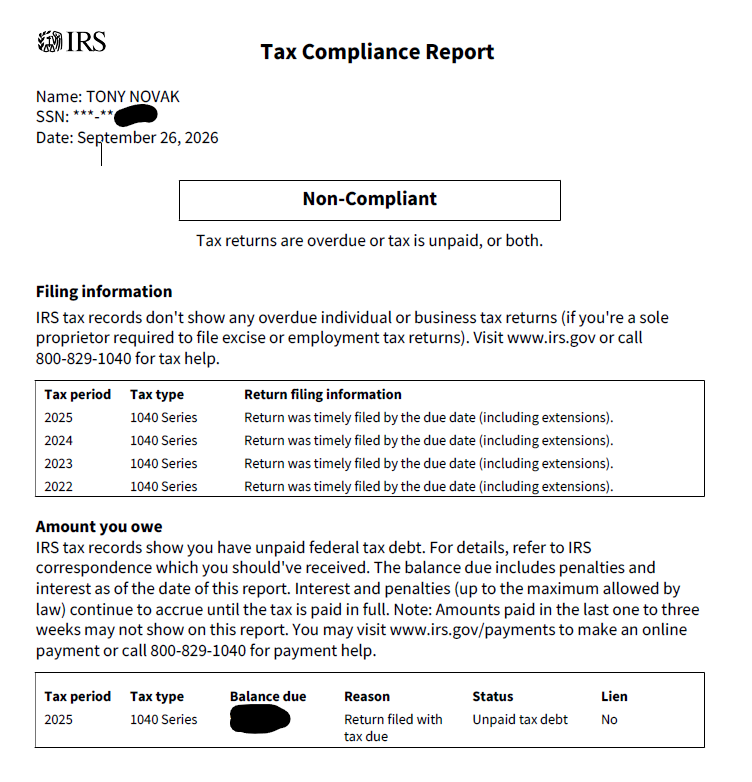
The IRS recently began offering Tax Compliance Reports to individual taxpayers. According to the Service, the report shows whether you filed your returns and paid your taxes on time, and you can download it when applying for a job, a loan, a government benefit, or another service that requires proof of tax compliance.
I pulled my own Tax Compliance Report today. It labels me “Non-Compliant” for 2025 and shows unpaid tax due. I will receive a refund for 2025, and I owe nothing. Yet the report, read on its own, says otherwise.
The report is not wrong in a technical sense. It is incomplete in a way that could harm taxpayers who are doing exactly what the law allows.
What happened
Each year, my spouse and I file separate returns first and later amend to a joint return. The tax code specifically permits this. Under Internal Revenue Code Section 6013(b), married taxpayers who file separately may switch to a joint return within three years of the original due date.
The reason is that I take significant business and legal risks as an environmental activist. That work draws opposition, and over the years I have been the subject of more complaints, investigations, fines, and threats than any other CPA I know. It is my choice, and it allows me to live in line with my values. It would not be fair to make my spouse share the possible financial exposure that comes with it. When spouses file jointly, each becomes responsible for the entire tax on the return, including any adjustment the IRS makes later. Separate returns also keep my spouse’s financial information out of reach of third parties seeking mine while the year remains unsettled. So we file separately, and we amend to a joint return only once I am confident the year is settled.
You don’t need to be an activist for this to matter. Business owners facing litigation, taxpayers expecting an audit, and anyone uncertain about a spouse’s finances may have good reason to file separately first. Filing separately usually costs more tax at first, and the savings come back only when the couple amends to a joint return. For some of us, it is a sound business, tax, legal, and financial planning strategy.
The separate return I filed shows a balance due. The joint amendment eliminates that balance and produces a refund. Until the IRS processes the amendment, however, its records reflect only the separate return. The compliance report therefore labels me noncompliant, even though I filed on time and am following a procedure written into the Code.
Why this matters
The report uses a single label for every taxpayer with a balance. A taxpayer awaiting a legitimate amendment receives the same “Non-Compliant” headline as someone who has ignored the IRS for years. The report offers no way to note a pending amendment, and a lender or employer reading it has no way to tell the difference. Amended returns commonly take four months or longer to process, so the label can persist well into the following year.
If I applied for a job, a loan, or a benefit program today, an automated screening system could reject me on the basis of this report. That would not be fair, which is why taxpayers in my position should act before anyone else sees the report.
What you can do
If you have filed an amended return, or plan to, I suggest the following steps:
- Pull your own Tax Compliance Report through your IRS Online Account before anyone else asks for it.
- If it shows a balance you expect an amendment to erase, keep a copy of the filed amendment and its status from the IRS “Where’s My Amended Return” tool to show any reviewer.
- If you need a clean report quickly for a loan or a job, consider paying the balance shown on the original return. The IRS will refund the overpayment when it processes the amendment.
- Remember that interest and penalties may accrue on the original balance while the amendment is pending. These should be removed once the amendment is processed, but you should confirm that they were.
The compliance report is a useful tool, and I expect lenders and agencies to request it more often. Taxpayers should understand what it measures and what it misses before it lands on someone else’s desk. If your compliance report shows something you don’t understand, let’s talk.